
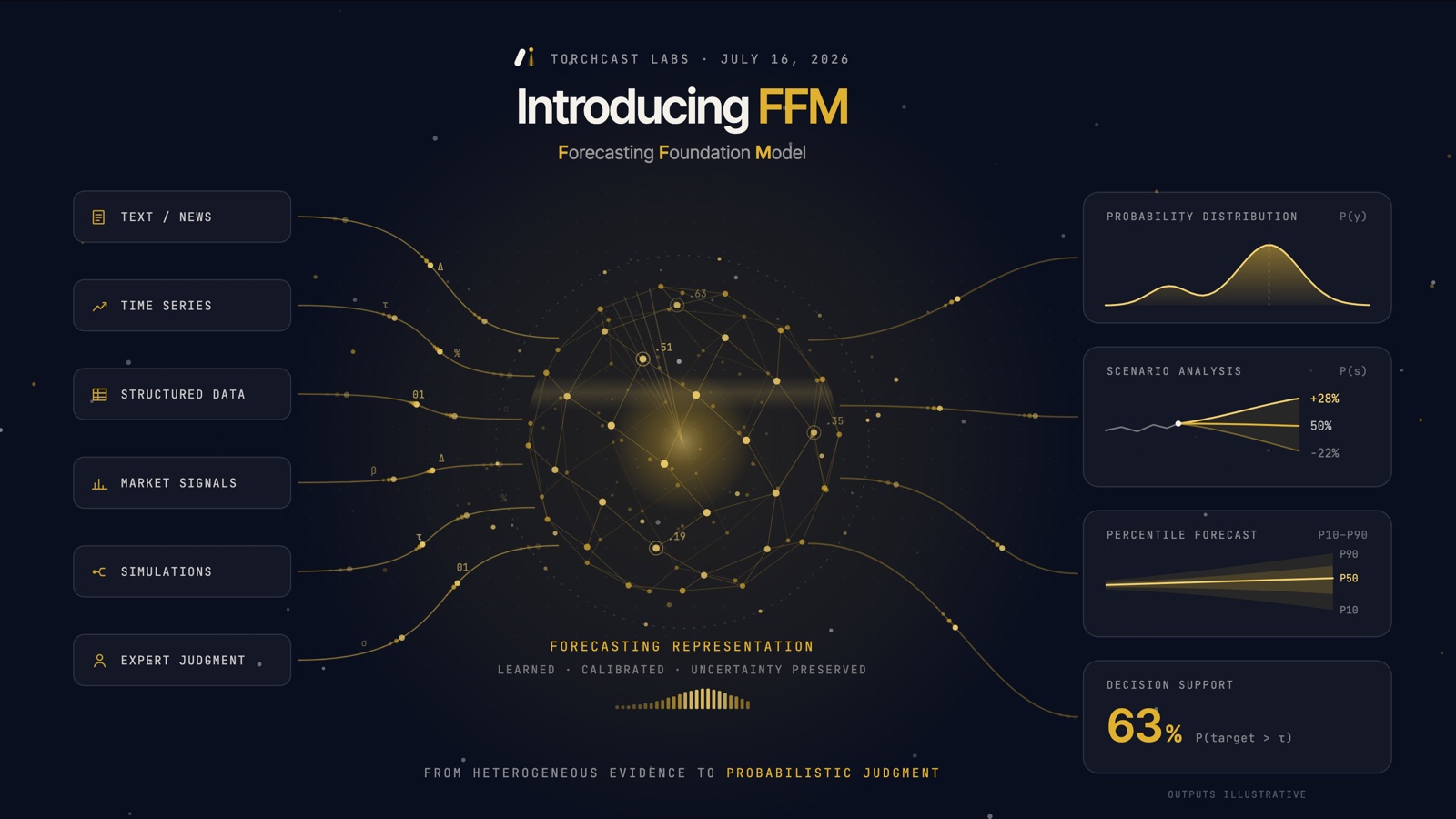
Today, Torchcast is announcing the Forecasting Foundation Model, or FFM, a research program focused on learning representations optimized for forecasting.
Torchcast began by training LLMs specifically for forecasting. Language was the right place to start because much of the evidence behind real-world outcomes lives in news, policy announcements, company disclosures, research papers, and expert analysis. We combined those models with proprietary research, retrieval, quantitative modeling, aggregation, and calibration.
As of July 16, 2026, Torchcast systems rank first, second, and third on the ForecastBench dataset leaderboard.
The result validated our first approach. It also made the next research question clear: what should a model learn when forecasting itself is the objective?
From LLM to FFM
Foundation models learn representations shaped by their objectives. LLMs learn representations of language through token prediction. Time-series models learn representations of numerical dynamics through sequence prediction. Forecasting draws on both, along with structured data, simulations, market signals, specialist forecasts, and expert judgment.
These inputs are not simply context to summarize. They are different observations of an evolving system. A forecasting model has to connect them, infer latent factors, preserve uncertainty, and recognize when signals are independent, duplicated, conflicting, or outdated.
FFM is designed to learn a shared representation of that forecasting problem. Inputs should retain their native structure rather than being flattened into prose. Specialized models can contribute what they understand best, while FFM learns how the signals relate and what they imply for possible futures.
Torchcast already produces calibrated probability distributions. FFM does not change the output format. It changes the internal representation from which those forecasts are produced.
Probability distributions are the natural expression of the learned forecasting representation. Resolved outcomes provide the signal by which that representation can be evaluated and refined.
A general forecasting representation could also support scenario analysis, decision support, and agent planning. Probabilistic forecasts remain the primary way it is expressed and judged.
What we are building
FFM is Torchcast's next major research program. It builds on our forecasting-trained LLMs, quantitative models, evidence systems, and operational experience. Those systems continue to power Torchcast and provide the data and capabilities behind this work.
The work is early. We will judge FFM by probabilistic accuracy, calibration, robustness to conflicting and duplicated evidence, transfer across domains, and measurable value in real decisions.
Torchcast began by using LLMs to forecast. We are now building a foundation model designed to learn the representation forecasting requires.