
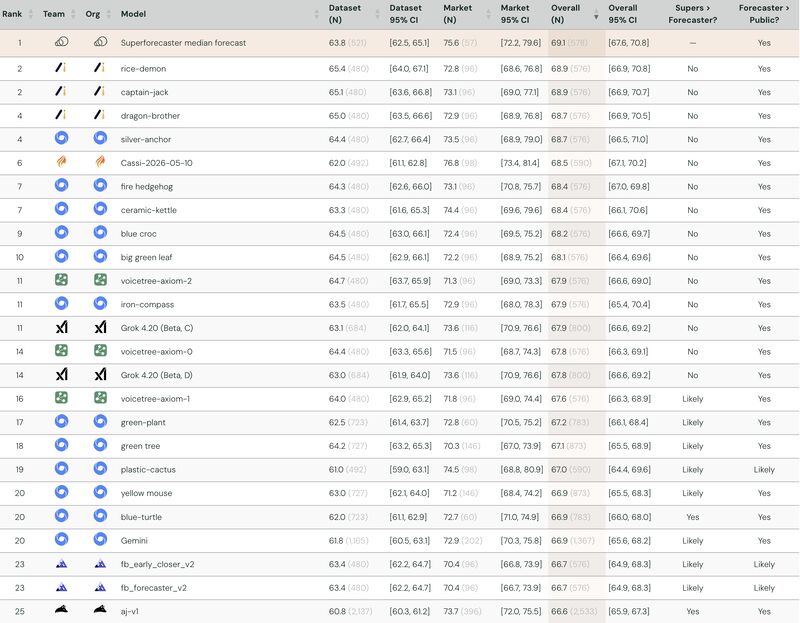
The Tournament result
On the Tournament leaderboard, our three systems finished:
🥇 captain-jack
🥈 rice-demon
🥉 dragon-brother
They rank ahead of every other AI system evaluated, including submissions from leading frontier labs. The only entry above our strongest systems is the median forecast of a group of human superforecasters — and ForecastBench's statistical analysis does not find that the superforecaster median significantly outperforms any of our three systems.
How we train
Our current systems are built on LLM foundations, but they are tuned specifically for forecasting. We do not optimize them to produce the most persuasive response. We train them to make better probabilistic judgments: to weigh evidence, avoid double-counting repeated signals, update beliefs as new information arrives, and stay calibrated over time.
ForecastBench gives us confidence that this philosophy works. It shows how far we can push forecasting performance by training today's language models around probabilistic judgment rather than next-token prediction alone.
Toward a Forecasting Foundation Model
That is the future we are building toward: a Forecasting Foundation Model that carries the same philosophy into the model itself, with representations and training objectives designed natively for forecasting. An FFM would learn forecasting-native representations from heterogeneous inputs: language, time series, structured data, market signals, simulations, specialist forecasts and expert judgment.
Rather than flattening everything into text, it would preserve the structure and uncertainty of each source, connect them into a shared forecasting representation, and turn that representation into calibrated probability distributions over real-world outcomes.
The hard part is not generating a prediction. It is learning which signals are genuinely independent, which merely repeat the same underlying information, which conflict or have become outdated, how reliable each source is, and how much new evidence should move the forecast. That is the probabilistic judgment we want to make native to the model.
The goal is not the most convincing prediction. The goal is to be uncertain correctly.